Each letter represents a focused, evidence-based stage of growth. The modules build on each other, but you can also enter wherever you are.
Every stage includes teaching grounded in validated psychology, reflection worksheets, real-life case studies, and the 6 P's framework applied to each theme.
This model applies to any life challenge — anger, grief, fear, self-doubt, overthinking, anxiety, depression, procrastination, and more. Whatever your dominating issue is, EMBRACE the journey.
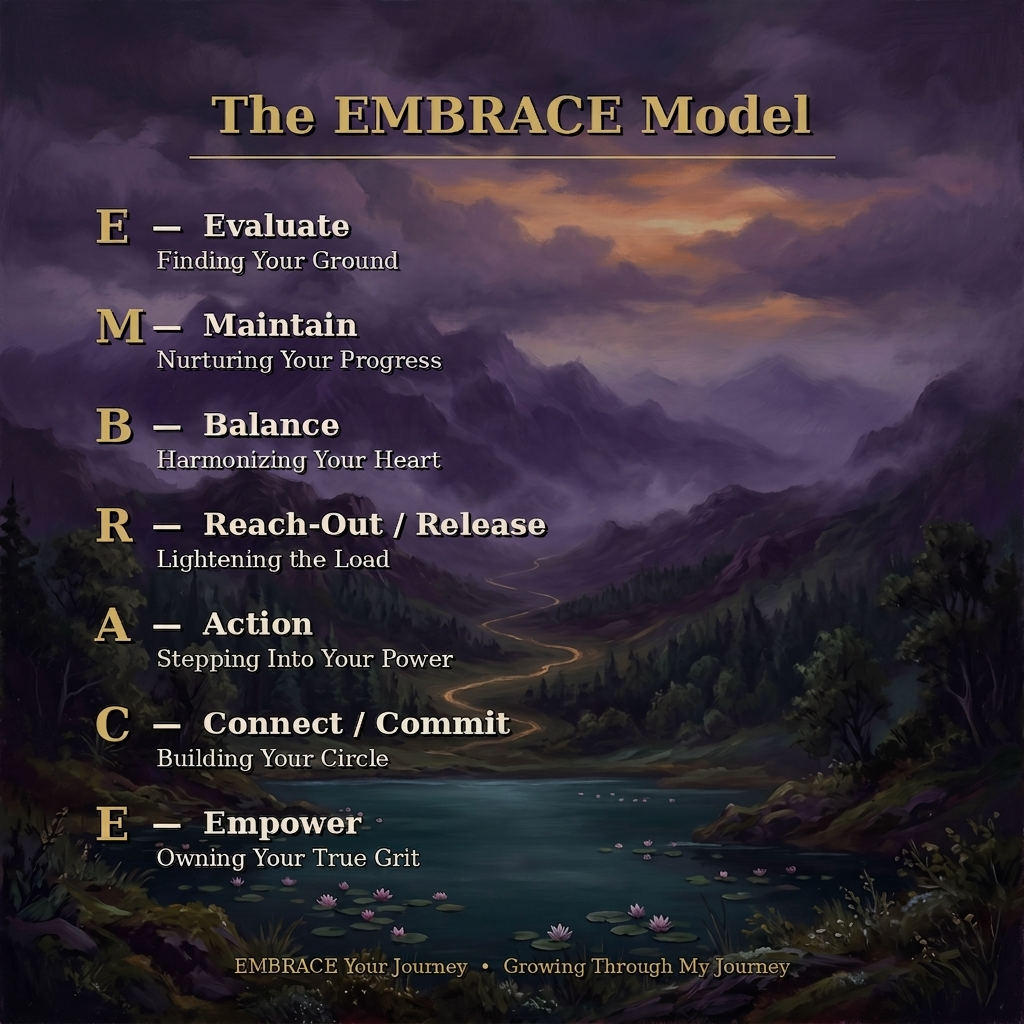
Identify your dominating issue. Distinguish root from fruit. Begin honest self-evaluation with kindness. This is where everything begins — telling the truth about where you are.
Build sustainable habits. Discover your minimum baseline. Learn why returning is not failing. Notice what you are already doing well.
Give your emotions a seat at the table. Learn regulation tools like the 5-4-3-2-1 Grounding Technique. Stop running from what you feel.
Identify what you've been carrying alone. Practice vulnerability. Release what no longer serves you through guided exercises like the Release Letter.
Turn insight into momentum. Set mini-milestones. Move forward without waiting for certainty. Action without awareness is just busyness — this module grounds your steps in truth.
Cultivate safe, real connection. Recommit to your values. Build the relationships that sustain growth. Connection starts with pausing long enough to notice what kind of support you actually need.
Claim the person you've been becoming. Celebrate your progress. Step into your next chapter. This is the 6 P's completing their cycle — you've earned this.
The 6 P's are the engine running beneath every module in EMBRACE. They are not arbitrary steps — each P corresponds to a validated psychological mechanism. Together, they move you from vague awareness into grounded, sustainable action.
These steps aren't always linear. Sometimes you Process as you Pinpoint — the understanding arrives in the same moment as the awareness. Trust the order that feels true for you.
The 6 P's apply to ANY life challenge — grief, anxiety, self-doubt, anger, procrastination, depression, and more.
Slow down. Become aware. Activates the parasympathetic nervous system.
Identify the issue clearly. CBT cognitive specificity techniques.
Understand it. Feel it. Emotional processing theory in action.
Choose your next honest step. Solution-focused frameworks.
Apply it in real life. Behavioral activation and habit neuroscience.
Notice how far you've come. Positive reinforcement and self-efficacy theory.
Most people want to jump straight from Pinpoint to Plan — skipping Process entirely. But feeling before fixing is not optional. It's the mechanism.
When we bypass emotional processing and rush to solutions, we build plans on unsteady ground. The insight doesn't stick. The behavior doesn't last. Process sitting before Plan is the most important sequence in this entire framework.
Process before Plan is what separates sustainable change from another failed attempt.
The same six steps live inside every part of EMBRACE — adapting to each theme while keeping the rhythm consistent.
You Pause to stop running, Pinpoint what's weighing on you, and Process what you find — before you ever make a Plan.
Maintenance is Practice made consistent. Pause when you fall off, Pinpoint what disrupted your rhythm, and Progress by returning — not restarting.
Process feelings without being ruled by them, then Plan small regulation strategies that actually fit your life.
Pinpoint what you're carrying alone. Process the weight of it — before you can Plan how to set it down.
Action without the 6 P's is just busyness. The framework ensures your steps are grounded in awareness, not reaction.
Pause long enough to notice what kind of support you actually need. Commitment is Progress made visible.
Empowerment is the 6 P's completing their cycle. You've Paused, Pinpointed, Processed, Planned, Practiced — and now you Progress into the person you've been becoming all along.
The EMBRACE Model and the 6 P's are built on established psychological frameworks — not trends, not opinions, not quick fixes.
Pinpoint uses cognitive specificity techniques to name issues clearly and accurately.
Embracing difficult emotions rather than avoiding them — the heart of the EMBRACE philosophy.
Pause activates the parasympathetic nervous system, creating space for awareness.
Plan draws from solution-focused frameworks to create honest, achievable next steps.
Practice reflects habit neuroscience — applying change in real life, imperfectly and repeatedly.
Progress leverages positive reinforcement and self-efficacy theory to sustain growth.
This workbook is intended for personal growth and educational purposes only. It is not a substitute for professional mental health treatment, therapy, or medical advice. If you are experiencing a mental health crisis, please contact a licensed mental health professional or call 988 (Suicide & Crisis Lifeline) immediately.
The case studies in this workbook are composite fictional characters created for illustrative purposes. Any resemblance to real persons is coincidental.